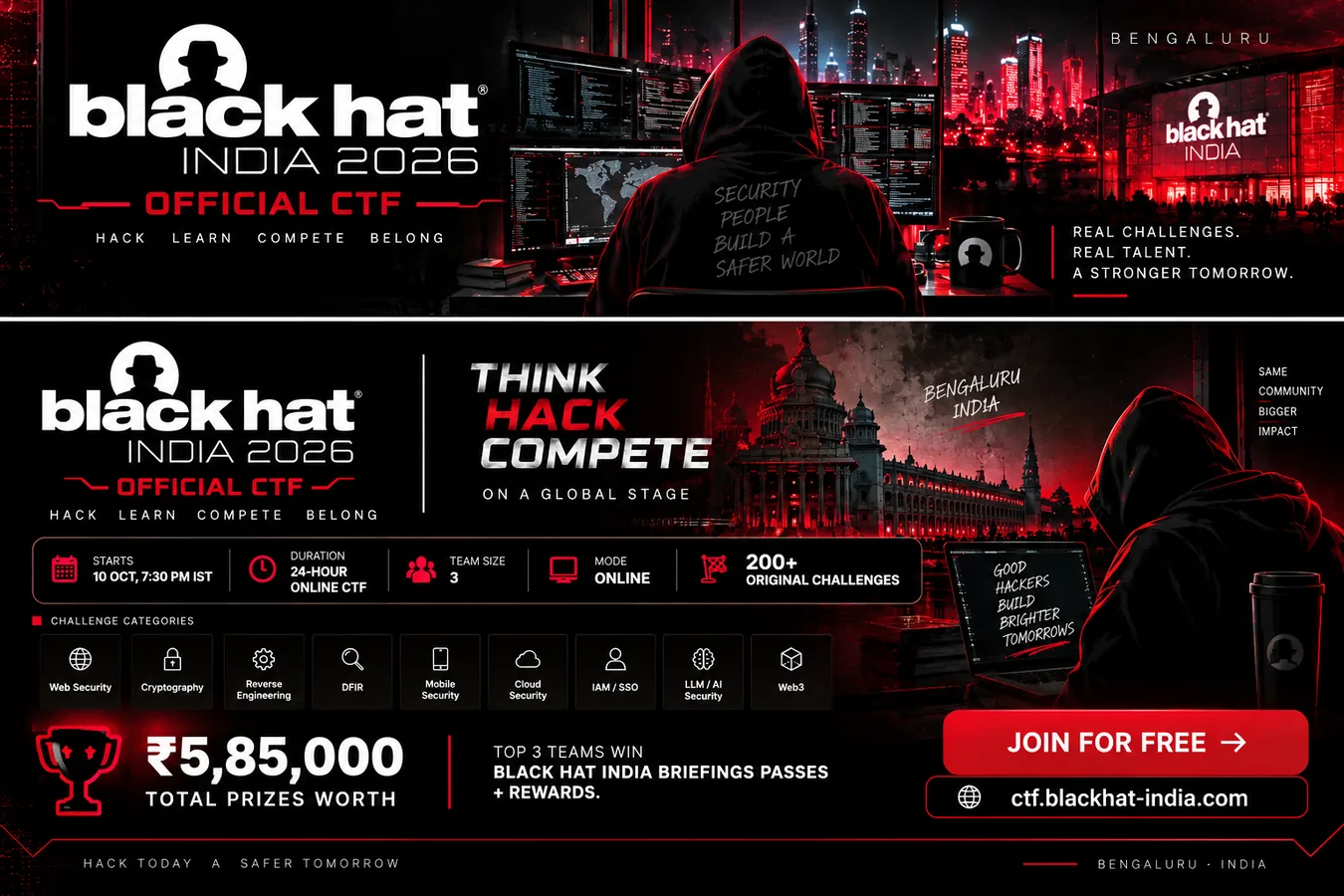
Black Hat India 2026 Official CTF
28 Nov 2026, 19:30 IST (14:00 UTC)
to 29 Nov 2026, 19:30 IST (14:00 UTC)
CTF7 is built in India for Indian cybersecurity events: college fests, conference tournaments, community chapters and hiring drives. Registration, challenges, the live scoreboard and certificates run on one platform, priced in rupees and supported in IST.
Capture The Flag (CTF) competitions in India are run mostly by colleges, conferences and security communities. Most Indian contests run as online jeopardy events, often culminating in an offline final during a college fest or conference.
Three kinds of organizer run most of them. Universities organize most of the country's competitions through student cyber clubs and tech fests. Community groups and student chapters keep meetups and practice drills going between semesters. Conferences host flagship tournaments that draw the strongest teams; many run on CTF7 and are listed on the events page. Alongside them, companies use hiring challenges to shortlist candidates on skill.
New to the format? Start with what a CTF is and our guide to event formats, then come back here for the Indian specifics.
These make up most of India's CTF calendar, and each has organizers who already host on CTF7 or partner with us.
More than 50 academic and community partners work with CTF7. If you run a club, chapter or conference, see the partner programs or tell us about your event.
28 Nov 2026, 19:30 IST (14:00 UTC)
to 29 Nov 2026, 19:30 IST (14:00 UTC)
Run registration, teams and a live scoreboard in one place. Free covers one jeopardy event a year for up to 50 players. Standard (₹9,999 per event, up to 500) adds custom branding, dynamic flags and anti-cheat.
Recently completed events are in the Past tab of the events page.
Trusted by conferences, universities and security teams that run CTFs on CTF7
Indian security competitions follow a familiar pattern. Plan for it and event day gets a lot calmer.
An online jeopardy qualifier, teams of 2 to 4, and an offline final during the tech fest. Many charge a small per-team registration fee, and participants usually expect a certificate. Our college CTF playbook walks through it step by step.
Many Indian organizers stitch together a registration site, a self-hosted scoreboard, Google Forms and a Discord or WhatsApp group. It works, but it means four tools, four logins and one very tired volunteer on event night. CTF7 puts registration, fees, challenges, scoring and certificates in one place.
Fest dates are set by the college calendar, and event prep often starts a few weeks out. Pick a platform with fixed, published prices that can be set up in days, and read how to host a CTF for the full timeline.
Prizes and certificates make flag sharing tempting. On Standard, dynamic flags, IP and browser tracking and submission logs give you evidence instead of arguments. Our anti-cheat guide explains what each one catches.
The right platform depends on your budget, your format and how much of the work you want to do yourself. Ask these questions before you commit:
Here is how CTF7 answers each one: why host on CTF7.
The CTF cost calculator compares self-hosting with managed hosting for your player count, event length and challenge mix, so you know your budget before you plan.
CTF7 is built by TachyonByte in Nashik for the events described on this page: college fests, community and conference competitions, and hiring drives. Registration, challenges, scoring and certificates all run on one platform, priced in rupees.
One free jeopardy event a year, up to 50 players. Standard is ₹9,999 per event for up to 500 players with dynamic flags and anti-cheat. Prices are published in rupees and charged per event, so a one-off fest doesn't need a monthly subscription.
Collect team or individual fees online as part of sign-up, so there are no separate payment links to reconcile.
Standard events get support over email and WhatsApp, the channels Indian organizers already use. Premium events get dedicated technical support.
CTF7 is built in Nashik, so the team you plan with works in IST, the same time zone as your participants, and knows how Indian college fests and conference CTFs run.
Student leaders get free access to CTFs and hackathons, swag, a certificate and LoR, and internship opportunities in event ops, content and challenge development.
Raw Ops bug hunting scored with CVSS 4.0, self-serve on Standard and Premium. Attack-defense, King of the Hill and SOC simulations run by our team as managed events, plus custom challenge development. Ask us which plan fits your format.
| What Indian organizers need | CTF7 | Typical DIY stack |
|---|---|---|
| Registration, teams & fee collection | Built in | Separate listing site + payment links |
| Scoreboard & challenge hosting | Hosted on every plan | Self-hosted server you maintain |
| Dynamic flags & anti-cheat | Standard plan | Plugins or none |
| Certificates for participants | Built in on paid plans; branded on Premium | Manual mail-merge |
| Event-day support | Email & WhatsApp on Standard; dedicated on Premium | Your volunteers |
Universities should also see CTF7 for universities; clubs, CTF7 for student clubs. Students who want their college to host can send their HOD our ready-made pitch.
You don't need a security degree or an expensive course. You need a laptop, curiosity and a team.
Read the beginner guideLinux commands, basic Python, and how HTTP and networking work. The categories guide explains web, crypto, pwn, reversing, forensics and OSINT, and the practice roadmap covers your first month. If you want practice operations after that, CTF7 War Zone bundles challenges, missions and raw targets into time-boxed operations, for ₹499 a month.
Most strong Indian teams grew out of a campus club. If your college doesn't have one, start it: your first jeopardy scrim of the year, for up to 50 members, is free on CTF7, and our guide to building a competition team covers roles and practice routines. School students can start with the beginner guide's section for school students.
Attend a security community or student chapter meetup in your city. It is the fastest way to meet teammates, mentors and the people who run India's CTFs. CTF7's community partners run events through the year.
Pick events from the events page. Beginner-friendly college CTFs are ideal first targets.
Write up your solves after every event (here is how to write a good one), then help run your college fest's security track. Organizing teaches as much as playing. The CTF7 Campus Ambassador program adds swag, a certificate, a LoR and internship opportunities.
CTF skills map directly onto the roles Indian employers hire for most: VAPT and penetration testing, application security, SOC analysis and incident response.
Much of India's VAPT demand is driven by regulation. CERT-In, the national computer emergency response team, maintains a panel of empanelled information security auditing organizations. Government bodies use these auditors, and some sector regulators require them for the entities they regulate. These firms need testers who can find real vulnerabilities and write clear, evidence-backed reports.
Flag-less formats train that skill. In Raw Ops, players submit vulnerability reports scored with CVSS 4.0, the same way a VAPT report is judged. Employers use hiring CTFs to shortlist on demonstrated skill, and the CTF7 job board lists security openings.
Web, API and network testing, and report writing. Practice with Raw Ops and web and pwn challenges.
Alert triage, log analysis and incident reports. Practice with forensics and SOC simulations.
Secure code review and threat modeling. Practice with source-available web challenges.
Reversing and binary exploitation. Practice with pwn and rev challenges and advanced labs.
If you are hiring in India, become a hiring partner and reach candidates by what they can do, not by keywords on a résumé.
A free jeopardy event for up to 50 players goes live when you publish it. For flagship events, our team can build the challenges and run the managed formats: attack-defense, King of the Hill and SOC simulations.